Why voice notes usually die
I’ve long had a simple but unpleasant problem: after negotiations, meetings and discussions there are too many nuances left that you can’t properly hold in your head.
During the meeting itself everything seems clear.
- The client clarified something.
- Somewhere the meaning shifted.
- Somewhere an important phrasing came up.
- Somewhere it became clear what the person actually needs.
- Somewhere a small detail appeared that could later grow into a task, a decision or a separate project.
And then the meeting ends.
And the usual loss of context begins.
You can turn on the voice recorder on your iPhone. But an audio file by itself solves almost nothing. The problem is getting the sound to become working text quickly.
I needed to get a transcript within about 10 minutes of a conversation.
Not through a separate service that you have to go to, upload a file, wait, check, and download the result.
I needed a proper path:
conversation › recording › transcript › text artifact › further work
The built-in phone solutions didn’t work for me.
Quality, stability, control, output format, further processing: all of it quickly runs into limits.
A phone is convenient as a recording point, but not as a full speech processing factory.
There is a whole class of devices that record you all day and transcribe automatically. The idea is clear: clip on a small recorder, it listens, then a service turns your day into text. But I didn’t want to buy a separate device, pay for a subscription and hand all that logic to an external system.
I decided long ago: if something becomes part of my memory, my workflow and my personal infrastructure, I want to understand how it works.
That’s how VoxBase appeared.
At first it was the answer to a very practical need: automatically turning iPhone recordings into transcripts.
But it quickly became clear that the task is broader.
This isn’t only about a voice recorder.
- There are voice notes.
- There are negotiations.
- There’s YouTube.
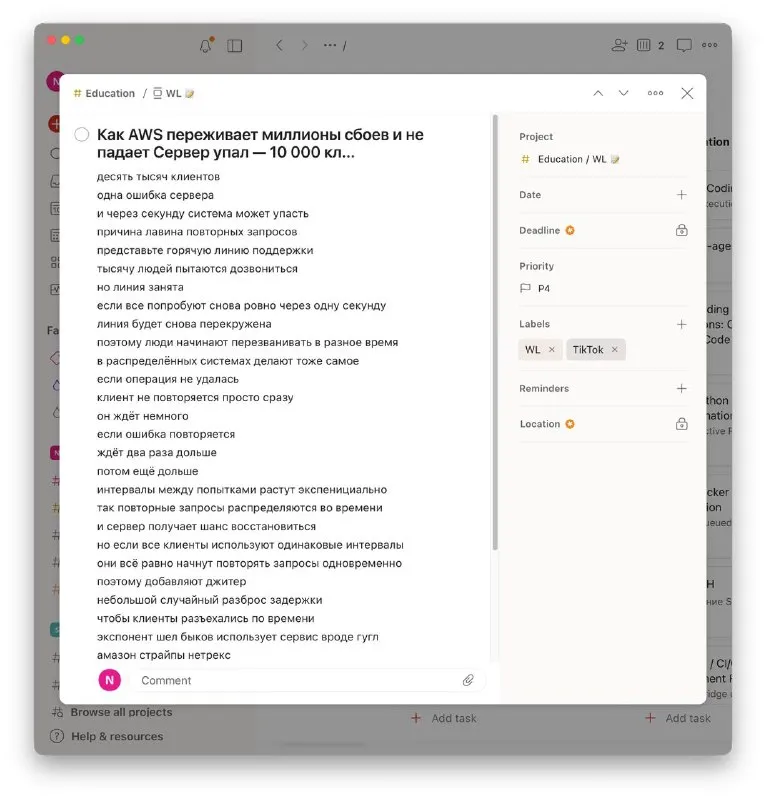
- There’s TikTok.
- There are podcasts.
- There are long discussions from which you need to extract meaning, decisions and next steps.
These are all different sources, but they share one problem:
important information often arrives as sound or video, while my working system lives in text.
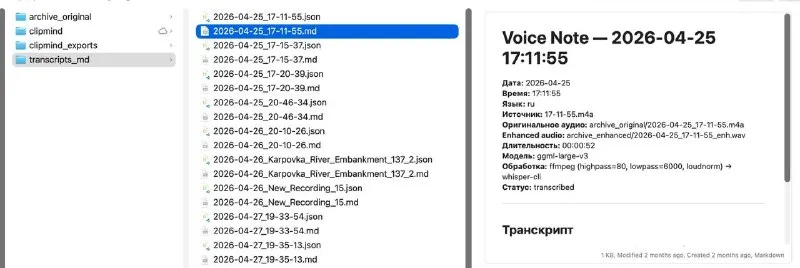
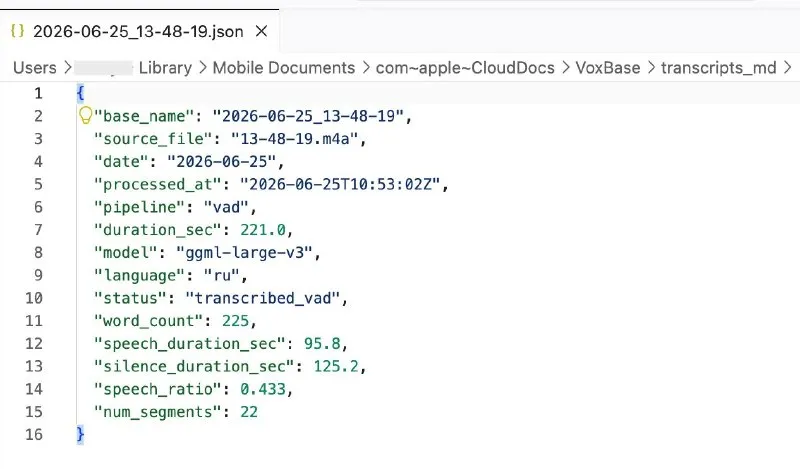
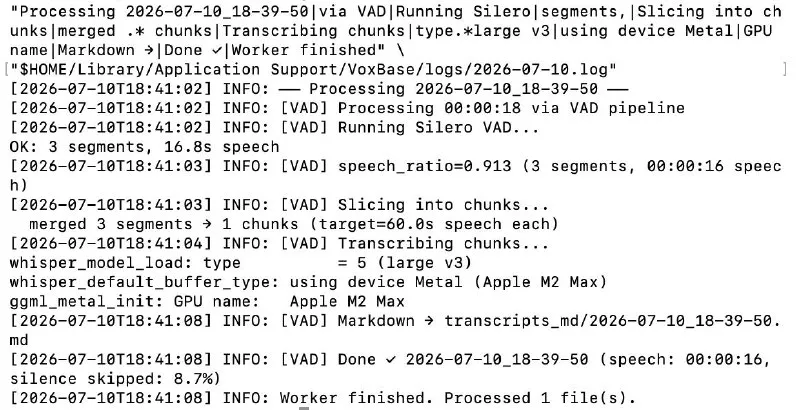
First the recording gets from the iPhone to the Mac. Then the system picks up the file on its own. Then the audio is processed. Then Markdown appears. Then that text can be read, searched, given to an LLM, turned into tasks, posts, notes and decisions.
That’s the first layer.
Other branches grew out of this idea: transcription of YouTube, TikTok, Apple Podcasts, and the next project, LiveContext, which is no longer about transcribing after a conversation but about real-time transcription while the conversation is still going.
But it all started with a simple thing.
I realised that after important conversations I don’t need an audio file.
I need memory.